
AFIS-Lite — AI-Assisted Forensic Fingerprint Platform
Fingerprint matching software tends to come in two extremes. On one end, NIST’s Biometric Image Software (NBIS) — a solid, free toolkit that gives you raw minutiae extraction and a matching score, with no image enhancement, no database search, and no case documentation. On the other end, full production AFIS platforms built for institutions with six-figure budgets and dedicated infrastructure teams.
There was nothing in between. AFIS-Lite is built to fill that gap — a fingerprint preprocessing, verification, identification, and forensic case-documentation toolkit, with an optional AI layer that explains and assists, but never decides.
What AFIS-Lite Actually Is
AFIS-Lite sits deliberately between NBIS and a full AFIS system, combining real preprocessing, every core matching mode, full case documentation, and an AI layer that supports — but never replaces — human judgment.
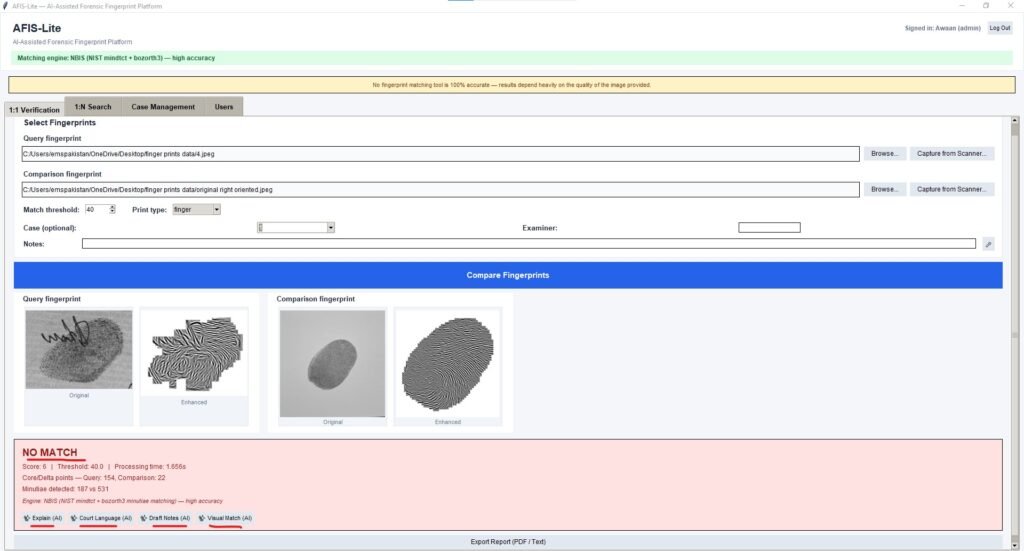
- 1:1 Verification — are these two fingerprints the same finger, with a documented preprocessing/enhancement stage ahead of matching. Covers plain, rolled (nail-to-nail), and — experimentally — latent (crime-scene lift) impressions.
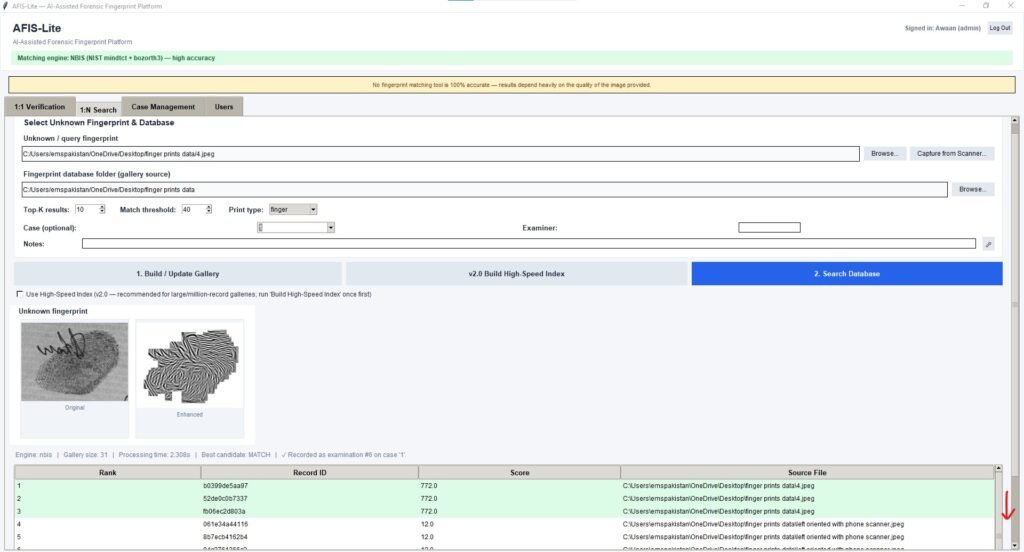
- 1:N Search — search one unknown fingerprint against a gallery of up to ~1,000,000 enrolled records, either as a brute-force scan or a FAISS-backed high-speed indexed search built for that scale.
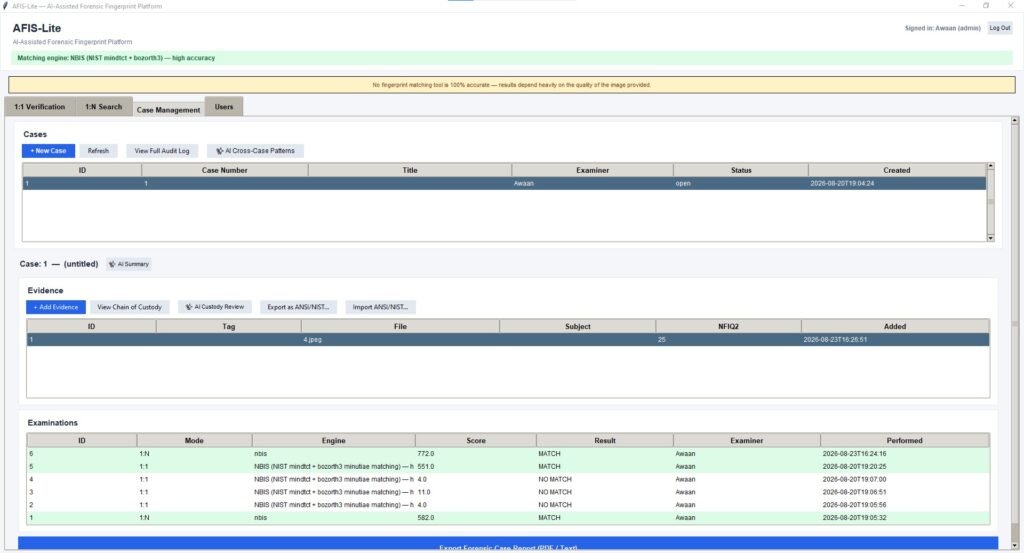
- Forensic case documentation — cases, SHA-256-hashed evidence, an append-only audit log, chain of custody, NFIQ2 image-quality scoring, examiner notes, and combined PDF/text case reports with the compared fingerprint images embedded.
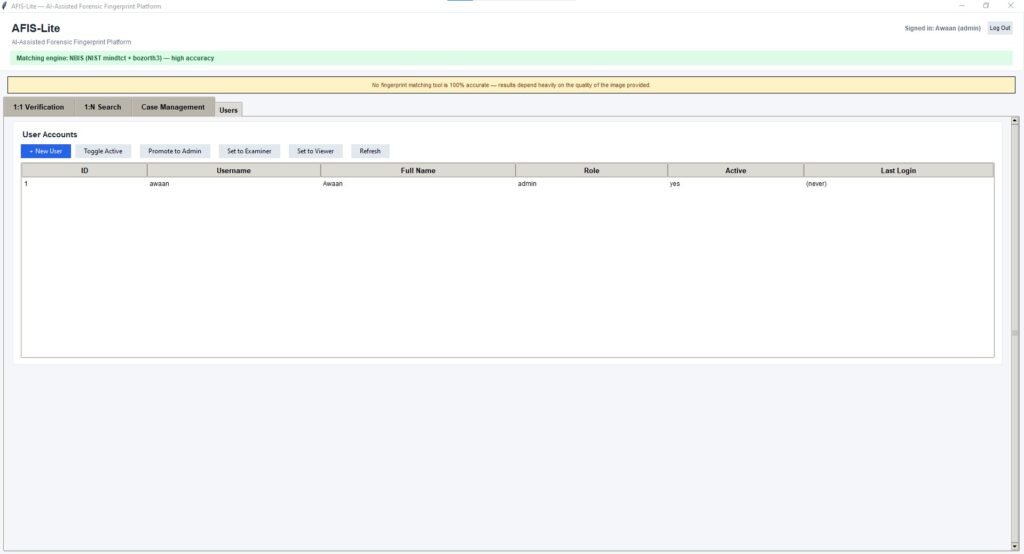
- Multi-user accounts and role-based access control — named admin/examiner/viewer accounts shared across every interface, so cases and examinations are attributed to real people.
- ANSI/NIST-ITL data exchange — export and import fingerprint records in the standard format used to share data between agencies and registries.
- Palmprint matching (experimental) — the same preprocessing pipeline extended to palm prints, with an honest, clearly-labeled accuracy caveat.
- Live scanner support — a plugin architecture for capturing directly from connected fingerprint hardware.
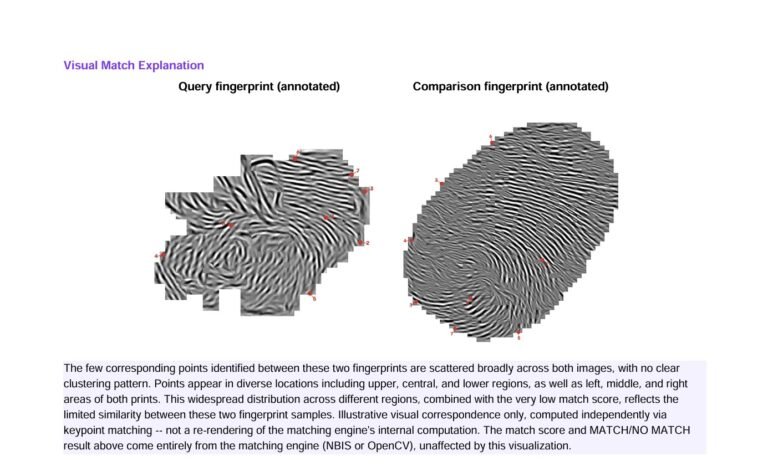
- AI Case Intelligence — an optional, provider-agnostic AI layer that explains results, drafts notes, flags patterns, visually illustrates why two prints correspond, and answers a question every existing AFIS tool leaves you to answer alone: what does this actually mean?
- Three interfaces, one backend — CLI, native desktop app, and web app, all reading and writing the same database, so nothing is duplicated or inconsistent between them.
Why AFIS-Lite Is Different
It’s not NBIS with a GUI bolted on. NBIS gives you two command-line binaries and nothing else. AFIS-Lite adds a real preprocessing and enhancement stage, a 1:N search layer NBIS doesn’t have at all, and a complete case-documentation system NBIS was never designed to provide.
It’s not a bare matching library. Open-source matching libraries give developers a matcher to embed in their own application — no GUI, no gallery workflow, no audit trail, no accounts, no data-exchange format. Useful if you’re building your own system from scratch; not useful if you need something that runs today.
It’s not a generic “compare two fingerprints” web toy. Those tools are typically opaque — no disclosed algorithm, no quality scoring, no record of what was compared or when.
It’s not an AI black box, either. AI Case Intelligence never touches a match decision. Every match score and MATCH/NO MATCH result comes entirely from the same NBIS/OpenCV engines documented throughout this toolkit, computed before any AI function runs — this is architectural, not a policy: no AI function in the codebase can accept fingerprint image or minutiae data as input. What AI does is explain, summarize, draft, and flag — always labeled as AI-generated, always reviewed by a human before it means anything.
And it’s honest about what it isn’t. AFIS-Lite doesn’t claim to beat NBIS or OpenCV on raw matching accuracy — it uses those same engines. Its high-speed indexed search and ANSI/NIST-ITL export are both explicitly scoped: genuine, working capabilities, described precisely rather than oversold. Palmprint and latent-print matching are labeled experimental because they haven’t been independently benchmarked. It doesn’t claim legal admissibility. Every boundary is stated up front.
AI Case Intelligence
An optional AI layer — powered by your choice of Claude or GPT, switchable with one setting — that supports the examiner without ever deciding the match:
- Explains a match result in plain language for a non-technical reader.
- Drafts examiner notes and report language — always a suggestion, always subject to review.
- Summarizes an entire case for a stakeholder who doesn’t need the full technical report.
- Flags duplicate evidence, chain-of-custody timing irregularities, and cross-case patterns a human reviewing cases one at a time might miss.
- Coaches capture quality in plain language instead of a raw NFIQ2 number.
- Transcribes dictated field notes via voice, in both the desktop app and the web app.
- Generates a point-to-point visual match explanation — both fingerprint images side by side with numbered markers on corresponding points and a plain-language caption, the same style of comparison chart used in commercial AFIS examiner workstations. The points shown are computed independently via keypoint matching and labeled throughout as “illustrative visual correspondence” — the match score and MATCH/NO MATCH result are entirely unaffected.
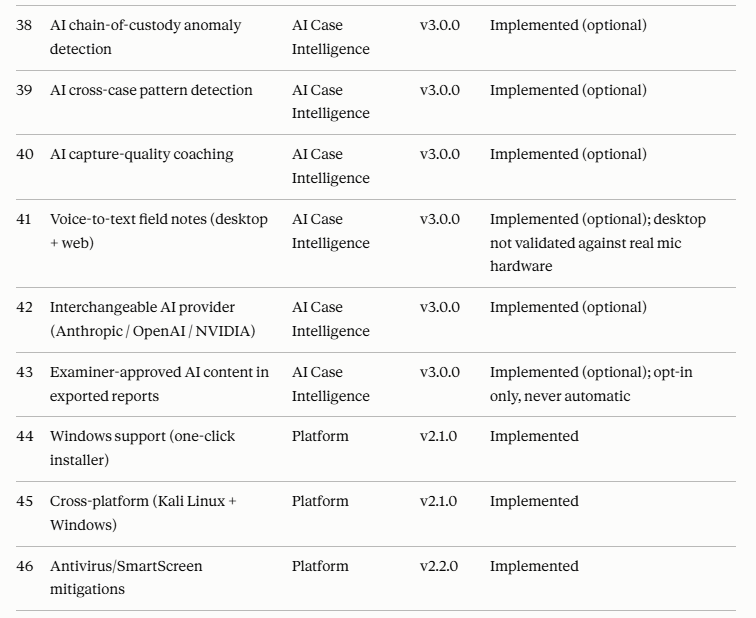
Complete Feature List
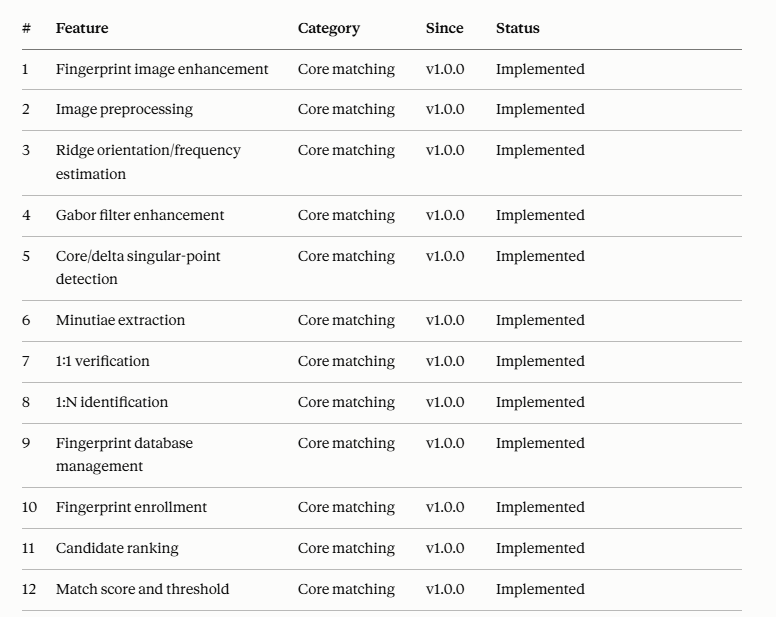
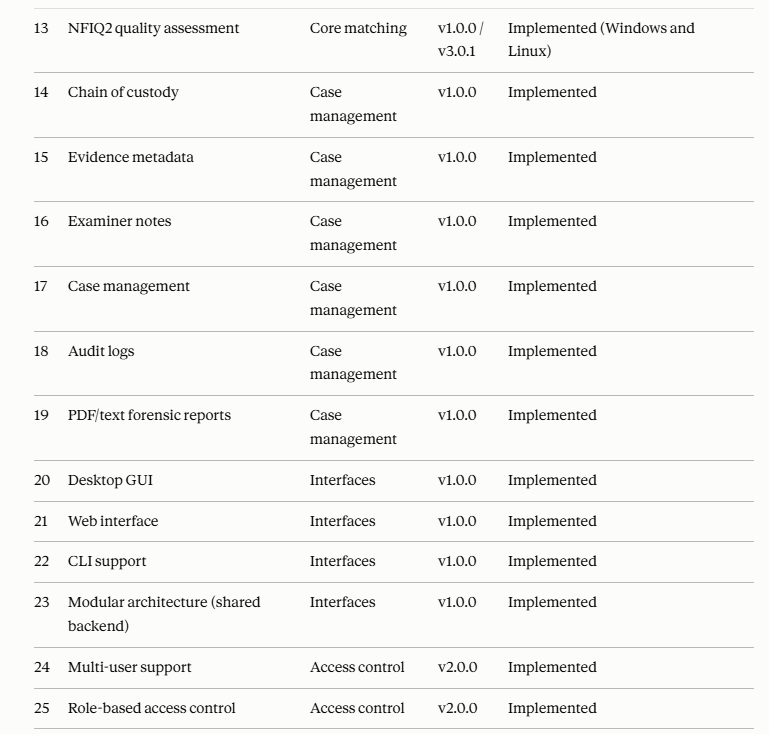
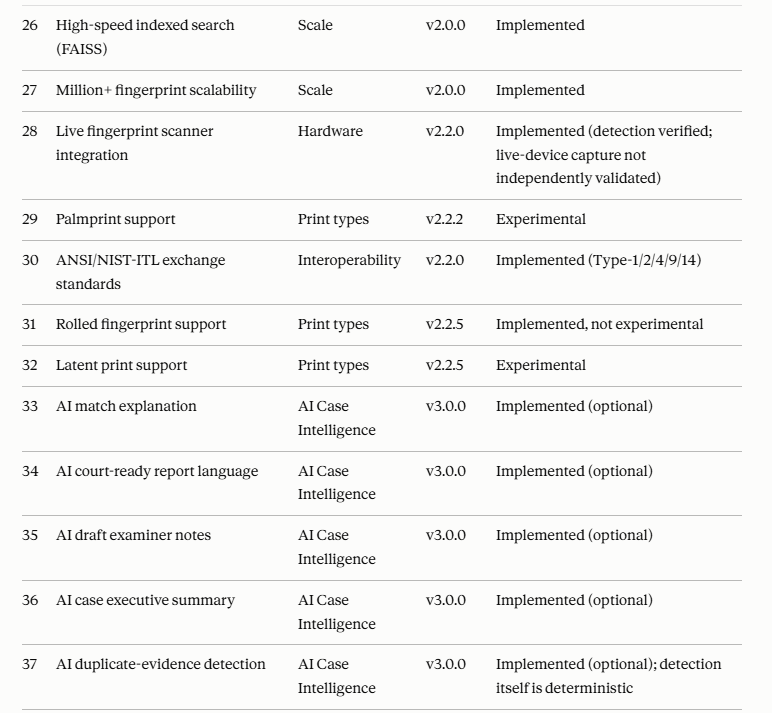
For anyone who wants the full picture, here is every capability implemented to date, flagged honestly as experimental or optional where that’s the case.
Who AFIS-Lite Is For
Police stations, courts, and forensic labs that need a working fingerprint verification and identification workflow without the cost of enterprise AFIS infrastructure — and universities and research centers where biometrics or forensic-science work happens and a transparent, documented research tool matters more than a black-box commercial system. Proper multi-user access control, standards-based data exchange, search that scales, and an AI layer that makes results easier to understand and document — all without ever touching the matching itself.
Research & Documentation
The full technical report — architecture, methodology, and an honest breakdown of accuracy limitations — is published as a preprint: